The Anatomy of a Painting
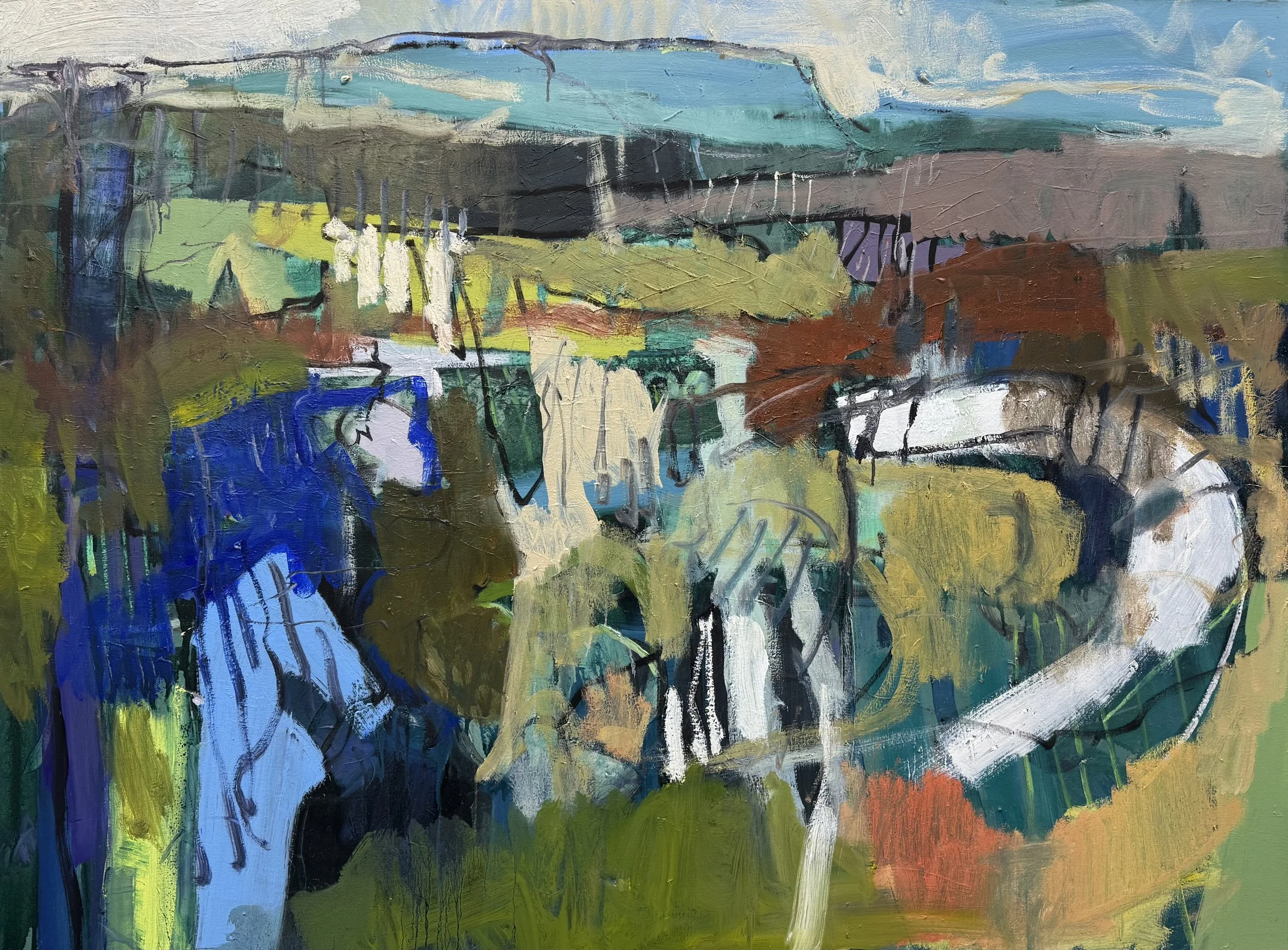
Each painterly decision alters the conversation between material and maker
Painting does not begin with the image but with the conditions that make the image possible.
Each material decision establishes a field of consequences within which thought itself becomes visible.
Martin Kinnear
To paint well, one must begin long before paint ever meets canvas. The finished image, however compelling, is only the visible residue of a chain of material decisions — each one a quiet negotiation between the painter’s intention and the medium’s reply. The process may look instinctive, but instinct in painting is rarely untrained. It is the accumulated memory of a thousand rehearsed choices: how to prepare a surface, how to pitch a tone, how to move from the general to the specific without killing vitality. In short, it is technē — the knowledge embodied in making.
My new RCA workshop, The Anatomy of a Painting, takes that idea as its starting point. Rather than treating painting as a series of fixed methods or borrowed recipes, it asks what actually happens when a painter constructs an image. From sizing to priming, blocking-in to varnishing, every stage opens a set of possibilities. What happens if the ground absorbs rather than reflects? What shifts when the underpainting is warm instead of cool? What visual rhythm follows from a brush held upright rather than canted? Each decision alters the conversation between material and maker. By noticing those points of choice — and the intervals between them — painters begin to recognise that the grammar of painting is not rule-bound but relational.
Historically, this attention to process was a given. Cennino Cennini’s Libro dell’Arte (c.1400) begins not with drawing, but with the making of gesso grounds and the tempering of brushes — an implicit understanding that artistry is inseparable from material preparation.¹ The seventeenth-century Dutch masters extended that logic: Rembrandt’s studio practice, as documented by Ernst van de Wetering, reveals a painter whose technical sequences were as deliberate as his iconography.² Sizing and imprimatura, for Rembrandt, were not perfunctory preliminaries but stages of invention. The initial stain established both tonality and mood; the weave of the canvas could be amplified or suppressed to catch the light like living flesh. In this sense, craft was already ontology: the material world asserting its being within the painted world.
In the nineteenth century, however, industrialisation and art education combined to split craft from concept. The tube of paint liberated the hand but obscured the ground. Where once each pigment was mulled, tested, and known, the ready-made palette created a disconnection between painter and matter.³ The academic atelier responded with procedural certainty — rules of underpainting, strict colour sequences, varnishing systems — which offered mastery at the cost of flexibility. The early Modernists, in rejecting that rigidity, often threw the baby out with the gesso. The studio became a site of expression rather than construction. But expression without structure can be as sterile as technique without thought.
What The Anatomy of a Painting proposes is a reconciliation: a way of recovering structure as a living framework rather than a cage. Each material choice, when understood rather than obeyed, becomes a means of invention. To prime or not to prime is not a matter of orthodoxy but of outcome. A sealed surface allows luminosity through optical layering; a porous one invites the pigment to sink and mattify, emphasising substance over sheen. The painter who recognises these distinctions begins to think not in recipes but in ranges — the spectrum of effects between opacity and transparency, thickness and glaze, ground colour and surface hue.
Lecture-demonstrations make this visible. When one sees a wash of terre verte spread over gesso and slowly warm under a veil of lead white, the alchemy becomes clear. The so-called “magic” of Old Master technique is simply a sensitivity to how materials behave when layered in sequence. The glaze that seems to glow from within is not an illusion but the physiological result of light scattering through a semi-transparent film — a phenomenon explained in modern terms by Kubelka-Munk theory but understood empirically by painters centuries earlier.⁴ Technē, in this sense, is embodied science: knowledge grounded in observation, refined through repetition, and expressed through touch.
Touch is where painting’s ontology begins to whisper. A line drawn with intent is an event, not merely a trace. The brush does not record an idea; it encounters resistance, drag, fluidity — all of which feed back into thought. This feedback loop between hand and matter is what Michael Baxandall called “the period eye”: a perceptual system formed as much by cultural habit as by haptic familiarity.⁵ When painters today learn to mix, test, and prepare their own materials, they are not being nostalgic; they are re-entering that dialogue between seeing and doing that underpins all visual understanding.
Each technical stage — sizing, priming, blocking-in, layering, unifying, varnishing, closing — serves as both a physical act and a conceptual hinge. Sizing isolates the support, stabilising it against absorption; metaphorically, it defines the limits of the painting’s world. Priming sets the tone, literally and figuratively, determining whether the ensuing image will float upon light or sink into shadow. Blocking-in establishes hierarchy: what is major, what is minor, where rhythm gathers or dissipates. Layering builds temporal depth — each stratum a moment recorded. Unifying brings coherence, often through glazing or scumbling, and in doing so reconciles accidents into intention. Varnishing seals, but also reveals: it re-saturates colour and completes the optical cycle of reflection. And closing — the most neglected act — is not simply the cessation of labour but the acceptance that a dialogue has reached its natural cadence.
Teaching these moments through demonstration allows students to witness range in action: not a formulaic sequence, but an orchestration. Every painter has a different sense of tempo — some push forward aggressively, others hover at the edge of indecision — but awareness of range allows both to find equilibrium. In my own demonstrations, I often begin with a restricted palette, working between a warm and cool primary, to show how tonal control can generate luminosity without excess chroma. When range is understood, harmony follows naturally; when it is ignored, paintings flatten or fracture.
This is where the language of taxonomy becomes useful. To speak of painting’s taxonomy is to acknowledge that its elements — value, hue, chroma, edge, composition, texture — form a relational system.⁶ Within that system, decisions about support or priming are not peripheral but structural. An absorbent ground lowers chromatic intensity, altering the relational field of colour. A glossy ground amplifies contrast and saturation. Such parameters are not purely technical but perceptual; they determine how a painting will be read by the eye. The painter’s task is to orchestrate these relationships consciously, so that form, colour, and surface operate as a unified syntax.
The workshop’s title, Anatomy, is therefore more than metaphor. Just as the anatomist dissects to understand the living body, the painter disassembles process to understand vitality. This approach restores agency to the act of making. Agency, in painting, is not the assertion of will over material but the reciprocal shaping of each by the other. The brush responds to viscosity, the pigment to light, the hand to resistance. This reciprocity is where ontology enters by stealth: the painting becomes a site of encounter between being and doing, a record of thought materialised through gesture.
Contemporary discourse sometimes frames this as a matter of “material agency” — the idea that substances act back upon the maker.⁷ But painters have always known this intuitively. When a glaze refuses to dry, when a pigment blooms unexpectedly into its underlayer, when varnish shifts the tonal balance overnight — these are not failures but conversations. The skilled painter learns to listen, not to dictate. In that listening, painting’s ontology becomes palpable: matter insists upon its nature, and the artist, in attending to it, discovers new possibilities of form.
The outward aim of The Anatomy of a Painting is practical, but the deeper ambition is pedagogical. Many painters, especially those re-entering oils after years in other media, struggle with uncertainty — too many methods, too few principles. By returning to technē, the workshop offers a framework that clarifies without constraining. It shows that technique is not a matter of correctness but of consequence. When you know why you size, why you block-in loosely before refining, why you unify with transparent passes rather than opaque corrections, you begin to build a personal grammar of making. That grammar, once internalised, allows freedom.
The painter who understands structure can improvise. Rubens, for example, moved fluidly between underpainting systems — monochrome, colour, or direct — depending on the expressive aim of each work.⁸ Turner’s experiments with grounds and mediums, though often chaotic, stemmed from the same awareness: that the image is an emergent property of material sequence, not an idea imposed from above. Even modernists such as de Kooning and Mitchell, whose gestural surfaces seem spontaneous, operated within an implicit structural discipline. The hand may appear free, but it is guided by an internalised sense of order — an anatomy of decisions rehearsed over years.
In lecture form, this becomes clear through demonstration. Watching pigment flow, seeing the interaction between lean and fat, between transparency and opacity, makes abstract principles tangible. The painter’s world is not built on theory but on small, reproducible actions: stretch, seal, stain, model, merge, balance, rest. Yet those actions, when consciously undertaken, become philosophical gestures. They assert that making is a form of knowing. To paint is to think through matter, not merely to illustrate thought.
This outward-facing understanding of painting aligns with a longer lineage of thought about technē. Aristotle distinguished between epistēmē (knowing that) and technē (knowing how), the latter grounded in practice and purpose.⁹ Heidegger later revisited the term, linking technē to poiesis — the bringing-forth of being into presence.¹⁰ Without wandering too far into philosophy, one might say that every well-considered brushstroke participates in that bringing-forth. It is an act of disclosure: the world made visible through human attention.
In a contemporary studio, this can sound grandiose, but its implications are simple. Painters who work with awareness of their materials engage reality at a deeper level. The grain of a panel, the absorbency of a ground, the drag of a bristle — these are not inconveniences to be controlled but conditions to be understood. Once understood, they become expressive tools. A chalky, absorbent ground can evoke the cool mattness of morning light; a resinous surface can carry the pulse of heat. The painter who learns to sense these correspondences begins to orchestrate not just images, but experiences.
At its heart, The Anatomy of a Painting is an invitation to re-imagine technique as thought made visible. It offers a structure for making and a space for invention — a way of uniting discipline and discovery. For students, this means reclaiming agency in their process: knowing when to follow method and when to deviate. For experienced painters, it provides a framework to revisit fundamentals without condescension — to rediscover the thrill of material encounter that first drew them to paint.
Every painting, however ambitious, is a chain of humble acts: stretching linen, laying gesso, mixing pigment, applying and adjusting. Yet in those acts, a profound dialogue unfolds between mind, hand, and matter. When painters attend to that dialogue — when they notice how each decision shapes the next — they move beyond imitation toward invention. That is the true anatomy of a painting: a living system of choices, structures, and responses through which vision takes form.
Footnotes
Cennino Cennini, Il Libro dell’Arte, trans. D.V. Thompson (New Haven: Yale University Press, 1933).
Ernst van de Wetering, Rembrandt: The Painter at Work (Amsterdam: Amsterdam University Press, 1997).
Philip Ball, Bright Earth: Art and the Invention of Colour (London: Penguin, 2001), pp. 164–179.
R. Kubelka and F. Munk, “An Outline of the Theory of Light Absorption and Scattering in Layers,” Zeitschrift für Technische Physik 12 (1931): 593–601.
Michael Baxandall, Painting and Experience in Fifteenth-Century Italy (Oxford: Clarendon Press, 1972).
Rudolf Arnheim, Art and Visual Perception: A Psychology of the Creative Eye (Berkeley: University of California Press, 1954).
Jane Bennett, Vibrant Matter: A Political Ecology of Things (Durham, NC: Duke University Press, 2010).
Julius S. Held, The Oil Sketches of Peter Paul Rubens (Princeton: Princeton University Press, 1980).
Aristotle, Nicomachean Ethics, trans. W.D. Ross (Oxford: Oxford University Press, 1908), Book VI.
Martin Heidegger, The Question Concerning Technology and Other Essays, trans. William Lovitt (New York: Harper & Row, 1977).